A weather forecast says 20 °C and you have no idea what to wear. A recipe asks for an oven at 180 °C and your dial is in Fahrenheit. Both problems have the same solution: one multiplication, one addition, and you are done.
The formula
To go from Celsius to Fahrenheit:
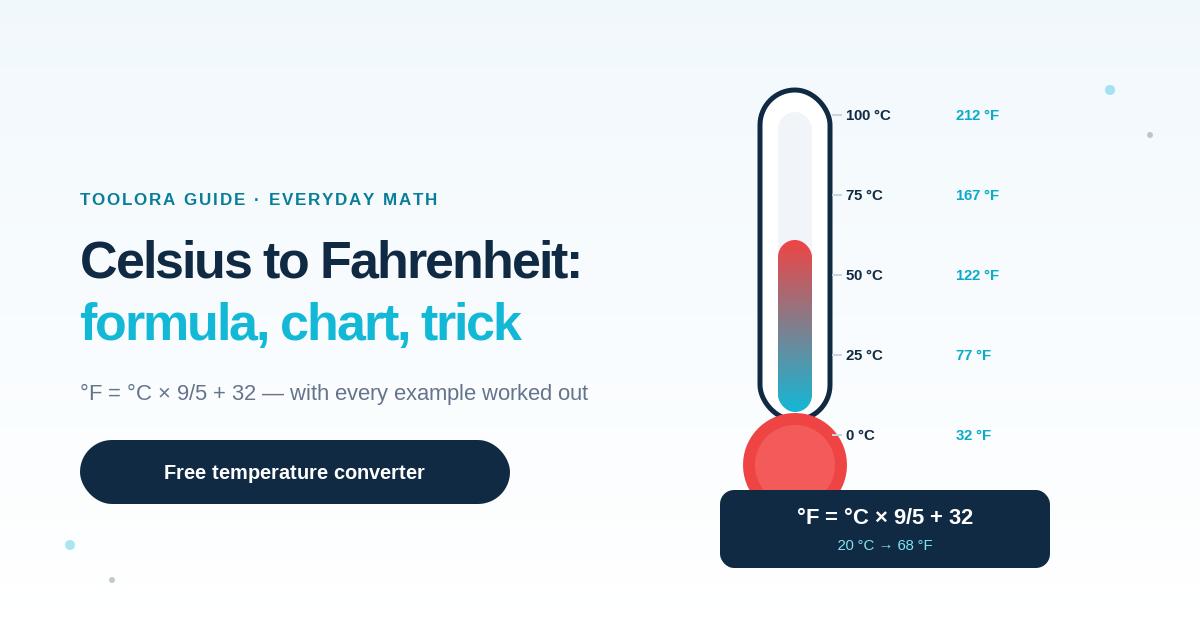
°F = °C × 9/5 + 32
Multiply by 1.8, then add 32. That is the whole thing — no lookup table needed.
Example: 20 °C becomes 20 × 1.8 = 36, then 36 + 32 = 68 °F. Body temperature, 37 °C, becomes 66.6 + 32 = 98.6 °F. Water boils at 100 °C: 180 + 32 = 212 °F.
Going the other way: Fahrenheit to Celsius
Subtract 32 first, then multiply by 5/9:
°C = (°F − 32) × 5/9
A 350 °F oven becomes (350 − 32) × 0.555 = 176.7 °C — which is why recipe writers round it to 180 °C. A 70 °F room is (70 − 32) × 0.555 = 21.1 °C.
The mental trick: double it and add 30
When you only need a rough idea — should I take a jacket? — double the Celsius value and add 30:
- 10 °C → 20 + 30 = 40 °F (exact: 50 °F — the trick underestimates cold values)
- 20 °C → 40 + 30 = 70 °F (exact: 68 °F)
- 30 °C → 60 + 30 = 90 °F (exact: 86 °F)
It is a decent approximation around room temperature and gets worse at the extremes. For cooking, science or anything that matters, use the exact formula or the free Toolora Temperature Converter, which also handles Kelvin and Rankine.
Celsius to Fahrenheit chart
| Celsius | Fahrenheit | What it feels like |
|---|---|---|
| −10 °C | 14 °F | Hard freeze |
| 0 °C | 32 °F | Water freezes |
| 5 °C | 41 °F | Cold, winter coat |
| 10 °C | 50 °F | Cool, light jacket |
| 15 °C | 59 °F | Mild spring day |
| 20 °C | 68 °F | Comfortable room |
| 25 °C | 77 °F | Warm, short sleeves |
| 30 °C | 86 °F | Hot summer day |
| 35 °C | 95 °F | Very hot — stay hydrated |
| 40 °C | 104 °F | Heatwave |
| 180 °C | 356 °F | Moderate oven |
| 220 °C | 428 °F | Hot oven, bread crust |
Convert any temperature now
Celsius, Fahrenheit, Kelvin, Rankine — free, instant, no sign-up.
Open the Temperature Converter →Why does the US still use Fahrenheit?
The Fahrenheit scale predates Celsius by about two decades (1724 vs 1742) and was already embedded in US industry, weather reporting and household appliances when the metric system spread through Europe in the 19th century. The US officially adopted metric units for science and trade in 1866, and a 1975 law encouraged voluntary metrication — but everyday life never switched. Today Fahrenheit survives in the US, the Bahamas, Belize, the Cayman Islands and a few other territories.
Where Kelvin fits in
Kelvin is the scientific scale: it starts at absolute zero and uses the same step size as Celsius, so K = °C + 273.15. That is why 20 °C is 293.15 K, and why Kelvin never takes a degree symbol. Rankine, used in some US engineering fields, is the Fahrenheit equivalent of Kelvin.
Frequently asked questions
Is 20 °C hot or cold?
20 °C (68 °F) is a comfortable room temperature — a light sweater or short sleeves both work. Below 15 °C (59 °F) most people reach for a jacket.
What is 180 °C in Fahrenheit?
180 °C is 356 °F, the standard “moderate” oven setting in European recipes — usually rounded to 350 °F on American dials.
Is 98.6 °F exactly 37 °C?
Yes: 98.6 °F is 37.0 °C. The figure comes from a 19th-century average; modern studies put normal body temperature slightly lower, around 36.5–37 °C.
Which formula do I remember?
Just one: °F = °C × 1.8 + 32. The reverse is °C = (°F − 32) ÷ 1.8. Everything else follows from these two lines.