Whether you sell products or services, knowing your profit margin is essential. It answers a simple but critical question: after paying for what you sell, how much is left for you? In this guide you will learn the formula, work through a real example, and avoid the most common confusion in business math: margin versus markup.
What is profit margin?
Profit margin is the percentage of your selling price that remains as profit after you subtract your costs. If you sell an item for $65 and it costs you $40, your profit is $25 — and $25 out of $65 is your margin.
The higher the margin, the more money you keep from each sale, and the more room you have to absorb unexpected costs, invest in marketing, or simply pay yourself.
The profit margin formula
Profit Margin = (Profit ÷ Selling Price) × 100
Notice that the profit is always divided by the selling price, not the cost. Dividing by the cost instead gives you the markup — a related but different number (more on that below).
Worked example
Say you sell handmade candles with these numbers:
- Cost per candle (wax, wick, jar, label): $40
- Selling price: $65
Step by step:
- Profit = $65 − $40 = $25
- Margin = $25 ÷ $65 = 0.3846
- × 100 = 38.46%
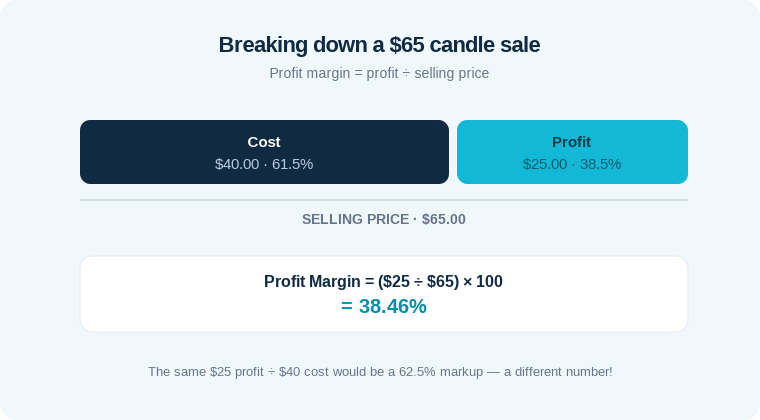
So for every $65 candle sold, about 38.46% of the price — roughly $25 — is profit. That is the number to watch when you negotiate with suppliers or plan discounts.
Margin vs. markup: don't mix them up
This is where most pricing mistakes happen. Both numbers use the same profit, but they divide it by different bases:
Markup = Profit ÷ Cost
With our candle example:
| Metric | Formula | Result |
|---|---|---|
| Profit | $65 − $40 | $25.00 |
| Profit margin | $25 ÷ $65 | 38.46% |
| Markup | $25 ÷ $40 | 62.50% |
Same product, same profit — two very different percentages. If your supplier says "apply a 50% markup" and you mentally convert it to a 50% margin, you will underprice your product. When in doubt, ask which base the percentage is calculated from.
What is a good profit margin?
There is no universal answer, but here are rough benchmarks by industry for gross margins:
| Industry | Typical margin |
|---|---|
| Restaurants / food service | 3–9% |
| Retail (general) | 20–35% |
| Consulting / services | 25–50% |
| Software / SaaS | 60–80% |
A "good" margin also depends on your volume, your fixed costs and how much growth you are reinvesting in. A 10% margin on high volume can beat a 40% margin on low volume.
Skip the math: use the free calculator
Instead of doing this by hand, enter your cost and selling price in the Profit Margin Calculator — it instantly shows your profit per unit, margin, markup and revenue. You can switch between USD, EUR, GBP and CAD.
Then take it further: the Break-Even Calculatortells you how many units you need to sell to cover your fixed costs, and the Percentage Calculatorhelps you model a price increase.
Calculate your profit margin now
Free, instant, no sign-up. Your numbers stay on your device.
Open the calculator →Frequently asked questions
What is the difference between gross and net profit margin?
Gross margin uses only the direct cost of your product (materials, manufacturing). Net margin also subtracts rent, salaries, taxes and every other operating expense — it shows what the business truly keeps. This guide covers gross margin.
Can profit margin be negative?
Yes. If your cost is higher than your selling price, every sale loses money. It happens more often than you would think with forgotten costs like packaging, payment fees or shipping.
How do I increase my profit margin?
- Raise prices (even 5% often has a big effect)
- Reduce cost per unit (bulk buying, better suppliers)
- Remove hidden costs (fees, waste, returns)
- Sell higher-margin products alongside your main offer
Is profit margin the same as ROI?
No. Margin relates profit to a single sale price; ROI relates the total gain of an investment to its total cost. Compare a marketing campaign with the ROI Calculator, and price a product with margin.