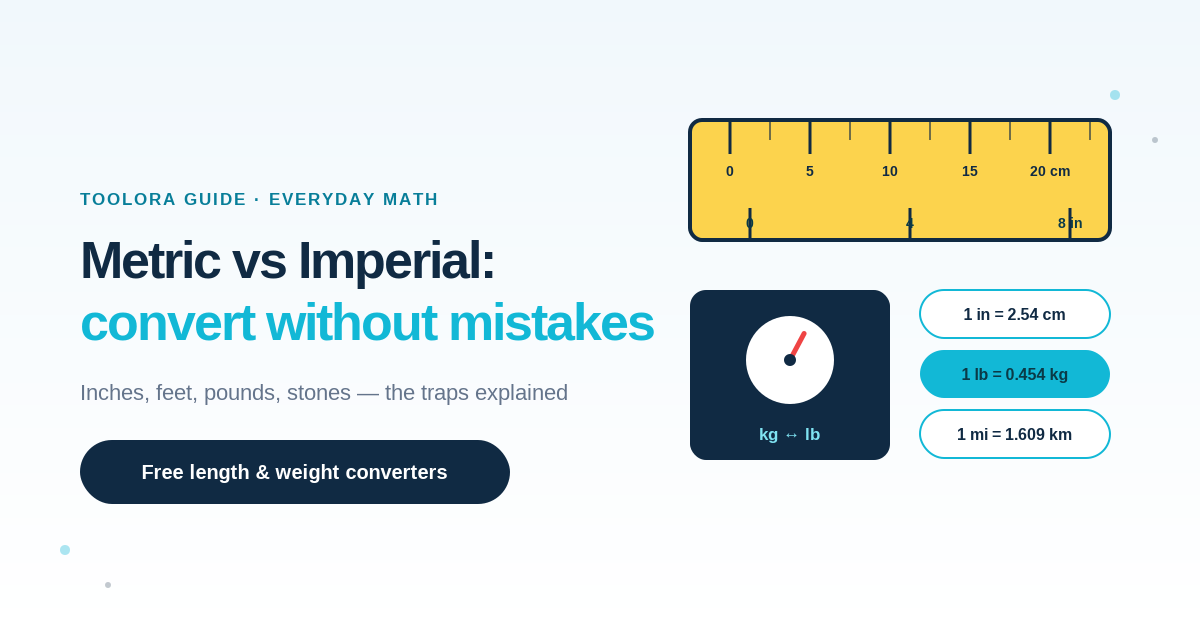
Metric is simple by design: everything is a multiple of ten. Imperial units grew out of everyday objects — a foot, a thumb, a grain — and were standardised later, which is why 1 mile is 1,760 yards and 1 pound is 16 ounces. Neither system is “wrong”, but mixing them without converting is how shelves end up 6 mm too long.
The two systems in one paragraph each
The metric system (officially SI) is used almost everywhere: millimeters, centimeters, meters and kilometers for length; milligrams, grams, kilograms and tonnes for mass; Celsius for temperature. Converting between metric units is a matter of moving the decimal point.
The imperial system — more precisely the US customary system — is still the everyday standard in the United States, and partly in the UK and Canada: inches, feet, yards and miles for length; ounces, pounds, stones and tons for weight; Fahrenheit for temperature.
Length: the conversions worth memorising
| Imperial | Metric | Memory hook |
|---|---|---|
| 1 inch | 2.54 cm | The only exact one — everything else follows |
| 1 foot (12 in) | 30.48 cm | A little over 30 cm |
| 1 yard (3 ft) | 0.9144 m | Just under a meter |
| 1 mile (5,280 ft) | 1.609 km | “A mile and a half” ≈ 2.4 km |
| 1 m | 3.281 ft | Roughly 3 feet 3 inches |
| 1 km | 0.621 mi | 10 km ≈ 6.2 miles |
A quick sanity check for furniture and travel: 1 inch is about 2.5 cm, so 60 cm ≈ 24 in and a 24-inch gap needs at least 61 cm. When the margin is that thin, convert exactly with the Toolora Length Converter.
Weight: the conversions worth memorising
| Imperial | Metric | Memory hook |
|---|---|---|
| 1 ounce (oz) | 28.35 g | Round to 28 g in recipes |
| 1 pound (lb) | 453.6 g | Just under half a kilo |
| 1 stone (14 lb) | 6.35 kg | UK body weight: 11 st ≈ 70 kg |
| 1 US ton (2,000 lb) | 907 kg | Lighter than a tonne |
| 1 kg | 2.205 lb | Double it, add 10% — close enough |
| 1 tonne (1,000 kg) | 1.102 US tons | A tonne is heavier |
For shipping, baking or fitness tracking, the Toolora Weight Converterconverts into every unit at once, so you can cross-check the result.
Convert length and weight now
Free, instant and private — everything runs in your browser.
Open the Unit Converters →The traps that cause real mistakes
- Fluid ounces are volume, not weight. A recipe asking for 8 fl oz of milk wants 237 ml, not 8 oz (227 g) on a scale.
- A stone is 14 pounds. Someone weighing “11 stone 4” is 71.7 kg — not 11.4 kg.
- US ton vs tonne vs long ton. 2,000 lb (907 kg), 1,000 kg and 2,240 lb (1,016 kg) are three different things. Freight quotes always specify which.
- US gallon vs imperial gallon. 3.785 L versus 4.546 L — a 20% difference hidden behind the same word.
- Oven temperatures are rounded. 180 °C is 356 °F, usually written as 350 °F, and 200 °C becomes 400 °F. A 25 °F gap rarely ruins a cake, but it matters for candy and bread.
Real-world conversion habits
Cooks convert ounces to grams once and write the gram value on the recipe card. Travellers learn two anchors — 1 mile ≈ 1.6 km and 1 kg ≈ 2.2 lb — and estimate from there. Shippers never estimate: they convert exactly, because a 1% error on a 20-tonne container is 200 kg of freight cost.
The safest habit is the simplest: keep a converter one click away and check the direction of the conversion. Most errors are not arithmetic errors — they are multiplying when you should divide.
Cooking is the most common place these traps bite. Our guide Cooking Volume Conversions: Cups, Grams and Milliliterscovers cups, tablespoons, butter sticks and recipe scaling in detail.
Frequently asked questions
Is the UK metric or imperial?
Both, officially. Roads use miles and speed limits in mph, beer is served in pints, and body weight is often in stones — while groceries, weather and most industry use metric units.
Why does the US use imperial units?
British colonial heritage plus industrial inertia. The US legally adopted metric definitions in 1866 and even defined its inch and pound through metric standards in 1959, but everyday units never changed.
How do I convert quickly without a calculator?
For miles to kilometers, multiply by 1.6 (or add 60%). For kilograms to pounds, double and add 10%. For inches to centimeters, multiply by 2.5. These estimates are within a few percent — use exact converters when precision matters.
Is weight the same as mass?
Strictly no: mass is the amount of matter, weight is the force of gravity on it. In everyday use — and in every converter on this site — the two words are used interchangeably.